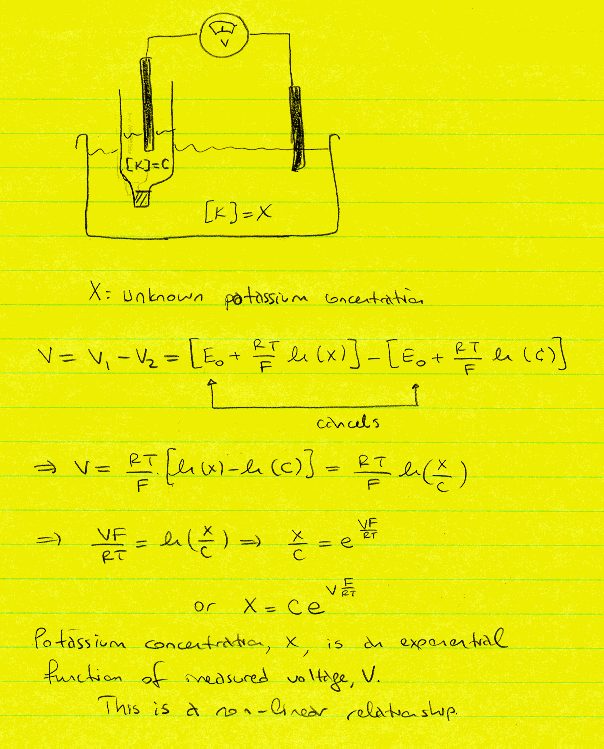
BE 490 / 590: IMPLANTABLE DEVICE TECHNOLOGY
SAMPLE PROBLEM SET # 3
ANSWER:
ANSWER:
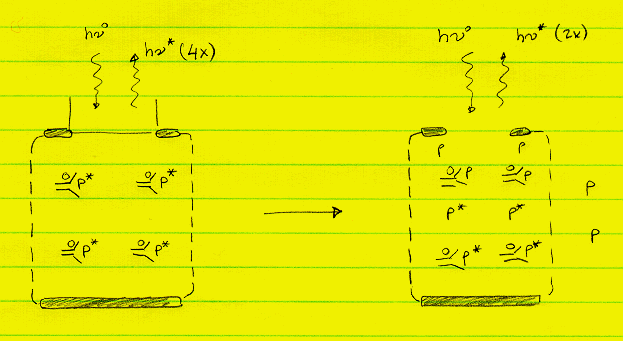
This sensory system consist of a light source (producing the incident h
n ), a light detector (sensing the returned/reflected hn ), an optical fiber catherter connecting the light source to the actual sensor, which is at the distal end of the catheter. Sensor consists of a dialysis bag which contains the antibodies (ABY) against the drug P. These antibodies are tagged with a fluorescent molecule which are symbolized with "o". Furthermore, the antigens (AGN - drug P) tagged with another fluorescent molecule symbolized with * are also in this dialysis chamber. On the absence of natural drug P, AGN* is docked on the ABYo, and their combined fluorescent characteristics are detected by the optical system. When the natural form of drug P diffuses in from the outside, it competitively bind to the ABYo, displacing the tagged AGN*. This reduces the intensity of the returned light. In other words, decreases in the fluorescent light is due to increases in the concentration drug P.
ANSWER:
ANSWER:
ANSWER:
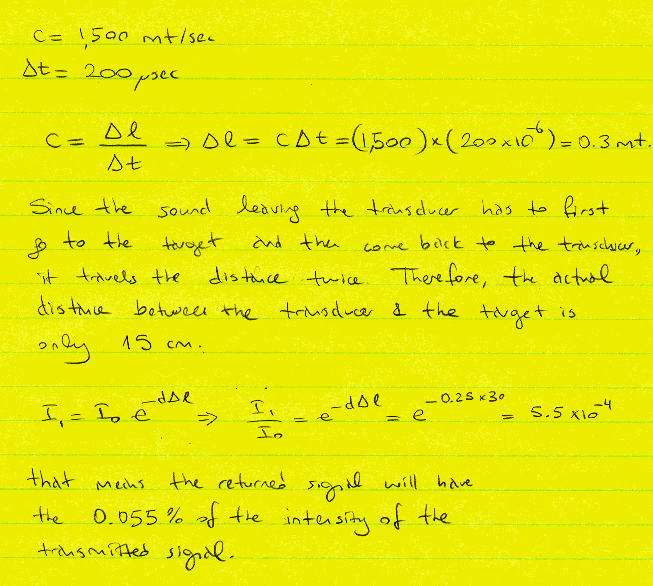
ANSWER:
T1 = 37
° C, T2 = 38° C, D T=1° C,Blood volume must be:
D V = 1 cm3 since the heat capacity of blood can be assumed to be 1° C/cm3-calorieFlow velocity can be found as v =
D V / A = 1 cm3 / 1cm2 = 1 cm/sec.
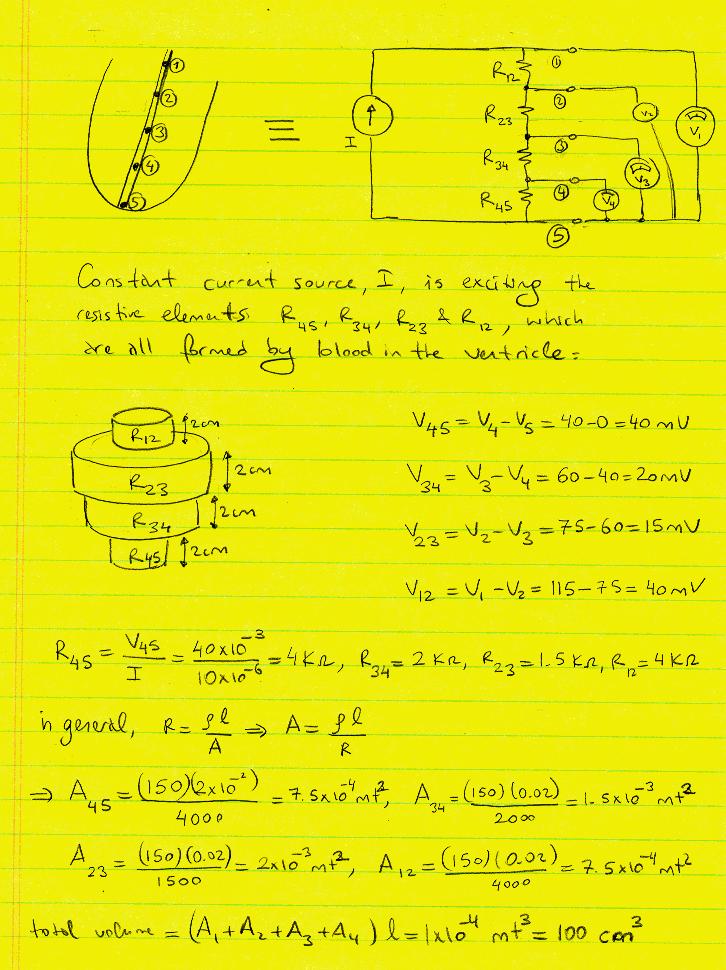
V1=115 mV, V2=75 mV, V3=60 mV, V4=40 mV,
Assuming that the resistance of blood is 150
W , calculate the ventricular volume.ANSWER:
ANSWER:
ANSWER:
Isotrophic etch removes silicon substrate at equal speed on each direction (omnidirectional). As a result of this, it creates geometries with smooth curves, not sharp edges. Agitation / no-agitation can be used to change the curvature to a certain extend, but sharp edges are not possible.
Anisotrophic etch removes silicon depending on the crystal orientation. By cutting the wafer on the direction desired, one can form desired geometries on selected orientation. Sharp corners with well defined edges are possible.
ANSWER:
Ratio of the vertical to horizontal dimension of a structure.
ANSWER:
Wet etch utilizes acids in a solution to remove the silicon from the crystal. One can change the reaction speed by changing the temperature. Etch direction can be changed by the orientation of the crystal.
In plasma etch, only the energy of the etchant is increased by application of RF energy. Furthermore, this process uses electric fields to drive the reactive agents directly into the silicon to control the etch direction. It is an active rather than a passive process.
ANSWER:
LIGA is similar to the plasma etch. Instead of RF energy, one utilizes the synchrotron to generate high energy particles to drive the reaction within the silicon. Since the energy of the particles produced by synchrotron is much higher than the one available from RF driven plasma etchers, LIGA can produce much higher aspect ratios than plasma etchers. Main problem with LIGA systems is the requirement for synchrotron particle accelerator.
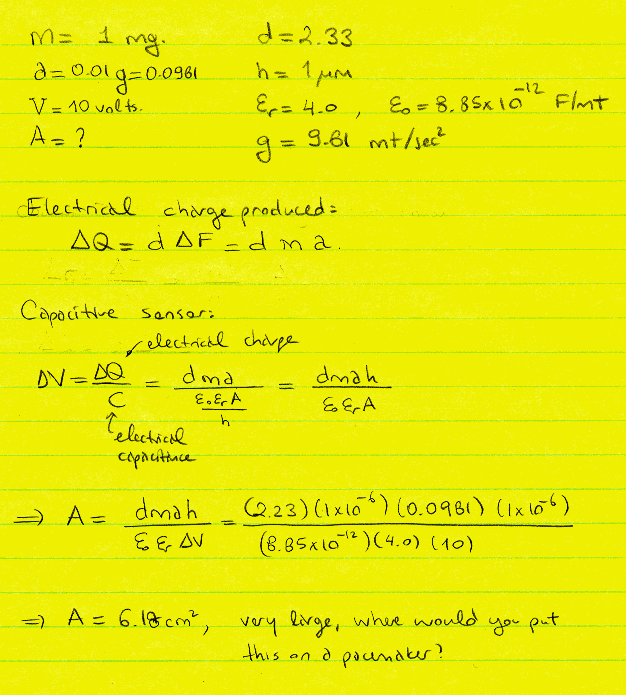
Electrical displacement constant, d = 2.33
Thickness, h = 1 micron
Relative permittivity,
e r = 4.0We also know that Permittivity constant,
e 0 = 8.85 x 10⁻¹² F/mt, and gravitational acceleration is g = 9.81 mt/sec2If we want the accelerometer to produce 10 Volts at 0.01 g, what should be the surface are of the piezoelectric film under the proof mass?
ANSWER:
ANSWER:
ANSWER:
RF (electromagnetic), acoustic, optical.
RF: most common, power needs to be limited to prevent tissue damage. Tissue and the metal case of the implantable device are all conductive, and forms a Faraday Cage, reducing the efficiency of communications. However, still used most widely because of enormous technical background available for RF communications from radio, TV, cell phone etc applications.
Acoustic: Suffers least amount of signal degradation with distance. Very harmless. Very prone to external noise and motion artifact. Used when simplicity is important such as trans-telephonic monitoring.
Optical: Signal strength degrades very rapidly (half of the power is lost in less than 1 mm). Used when the bandwidth is very important, i.e. when there is a lot of data to be transmitted.
ANSWER:
Parity: a method to detect and possibly correct single bit errors in digital communications
Even parity: Parity bit is set to "1" if the number of 1's in a byte is an even number.
Example: Even parity bit for 00101101 will be set to 1, since there are four 1's.
ANSWER:
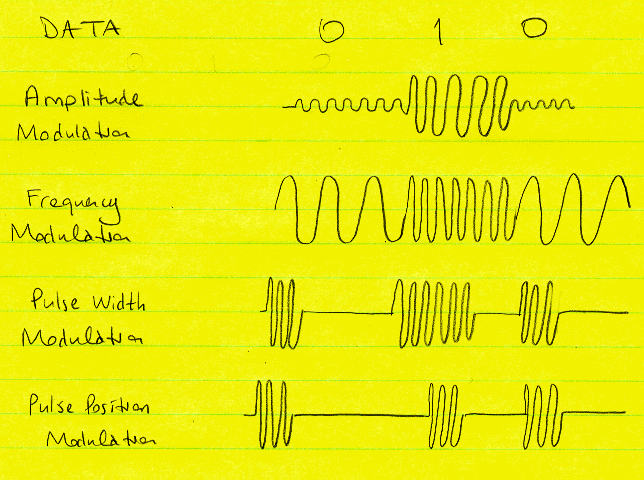
Modulation: Modification of the characteristics of a carrier signal in accordance to the data to be transmitted.
If not modulated, data transmission will have a lot of noise, will mix up with other signals, or may not even be received at the receiver (as in the case of coupled RF coils).
ANSWER:
Morse code is more efficient because shorter codes are assigned to data symbols which occur frequently. In ASCII, all codes are the same length, so it takes just as long to transmit/store the frequently used symbols as the rarely encountered ones. A code for storage or communications is efficient if the coded volume is less than the generic uniform code (as ASCII).
1, 1, 1, 1, 1, 1, 2, 2, 1, 1, 1, 2, 3, 4, 2, 1, 1, 1, 2, 3, 4, 2, 1, 1
ANSWER:
Probability table will be as follows:
|
X |
N(X) |
P(X) |
|
1 |
14 |
7/12 |
|
2 |
6 |
3/12 |
|
3 |
2 |
1/12 |
|
4 |
2 |
1/12 |
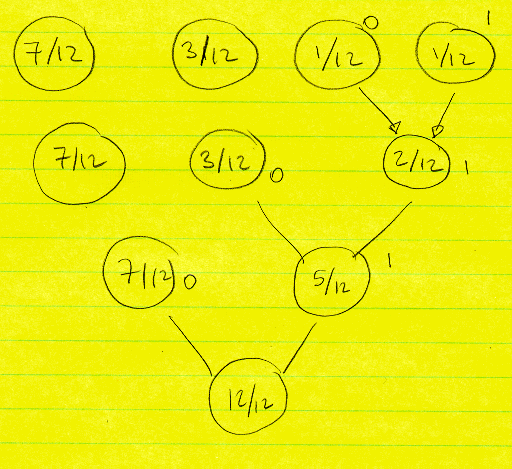
Code assignments will be as follows:
|
1 |
0 |
|
2 |
10 |
|
3 |
110 |
|
4 |
111 |
ANSWER:
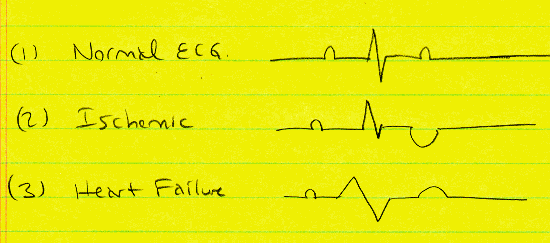
Template matched compression for storage / transmission algorithms are efficient when the data being stored / transmitted is a periodic signal which is repeating, such as ECG. Instead of storing each beat in great detail, we store couple of templates, and log only the template number for each cycle. If the new data does not match to any of the stored templates, then we save that cycle as a new template.
Here is an example:
1111111111111111122222222222233333333333333333